
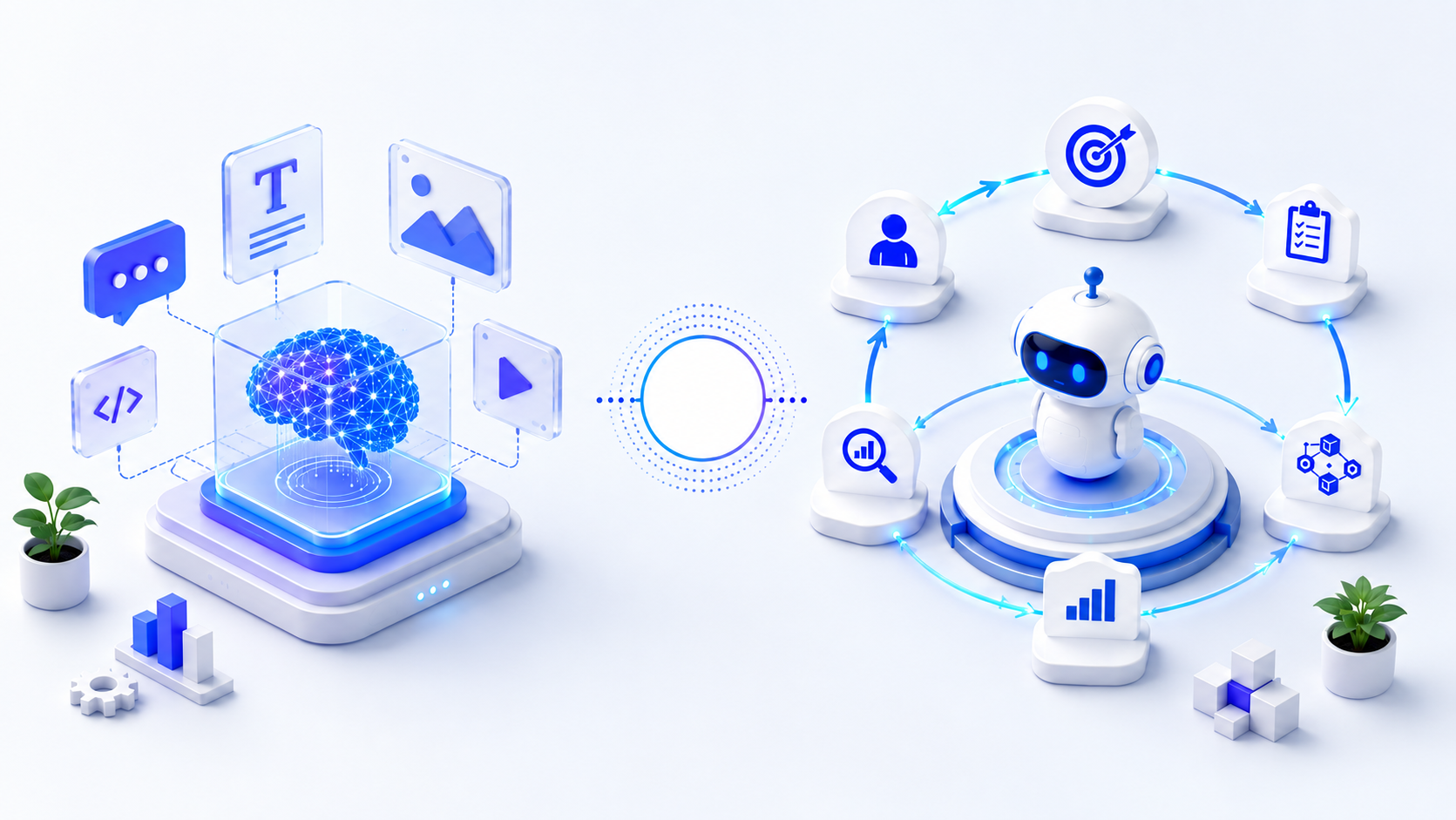
What Is Generative AI?
Generative AI refers to AI systems that create new content text, images, code, audio, video in response to a prompt or instruction.
The model receives input, processes it against its training, and generates output.
The defining characteristic of generative AI is that it responds. Generative AI is primarily designed to respond to prompts, although it can also be connected to tools and workflows that allow it to perform additional actions. A user provides a prompt; the model provides a response. The interaction ends there.
Generative AI can include technologies such as:
- Large language models that write, summarize, translate, and answer questions
- Image and video generation models
- Code generation tools
- Speech synthesis and audio generation
- Multimodal systems that work across text, image, and audio together
The technology itself is only part of the picture. The value comes from connecting these capabilities to the right workflows with appropriate controls around what the model can see and what it can produce.
What Is Agentic AI?
Agentic AI refers to AI systems designed to pursue goals with varying levels of autonomy, planning steps, using tools, taking actions, and adapting based on results.
Where generative AI responds to a single prompt, an agentic system receives a goal and works out how to achieve it. That typically involves:
- Breaking a goal down into steps
- Deciding which tools or resources to use for each step
- Executing actions searching the web, writing and running code, calling APIs, sending emails
- Evaluating the results and adjusting its approach based on what it finds
- Reporting back or continuing without a human checkpoint
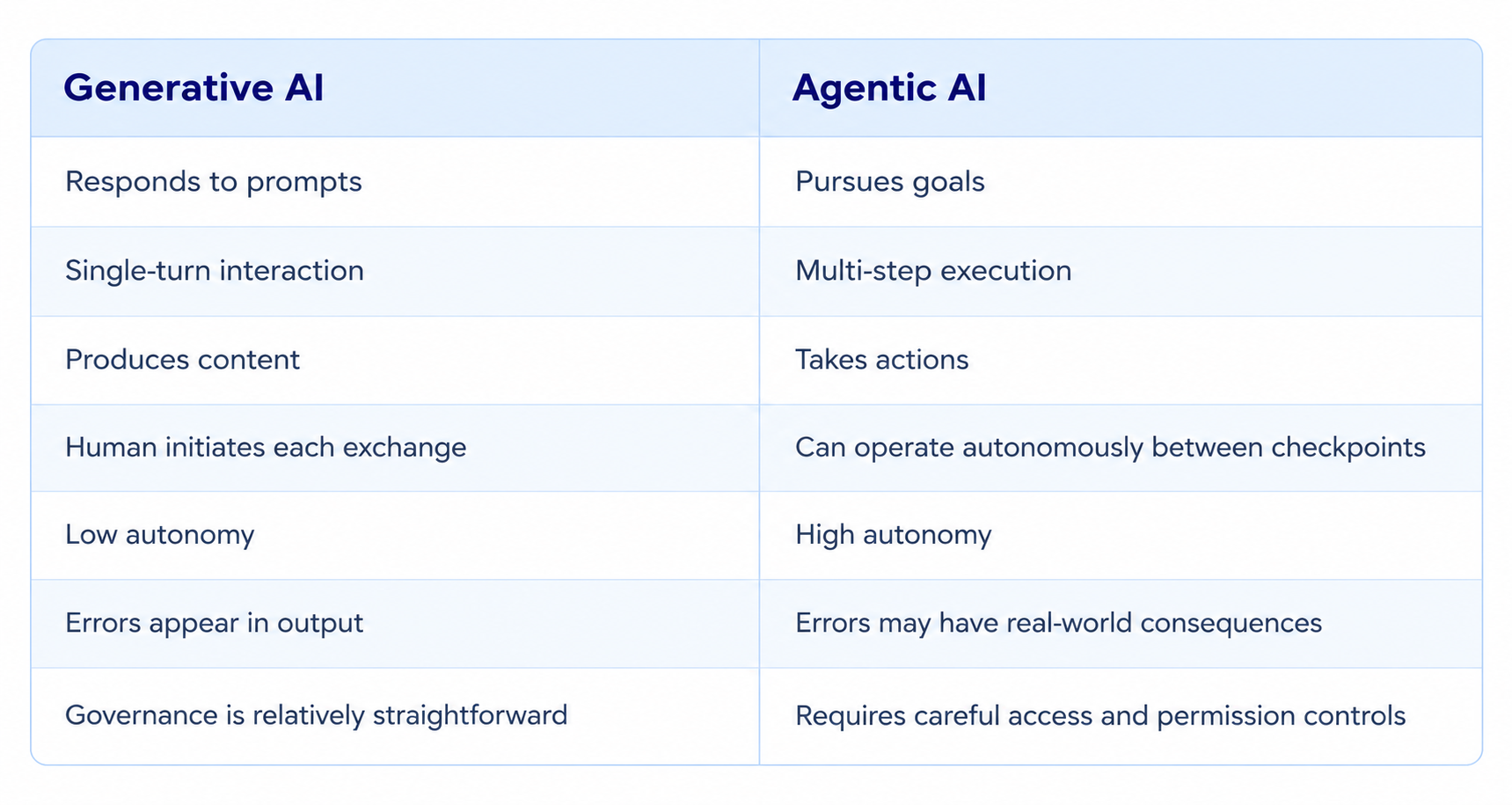
The defining characteristic of agentic AI is that it acts. It doesn't just generate output; it does things in the world. That distinction matters enormously when it comes to assessing risk.
How Are Generative AI and Agentic AI Different?
The differences go well beyond the technical. They affect how you deploy, govern, and take responsibility for AI systems.
The governance framework you need for agentic AI is more like the framework you'd build around a new employee with broad system access than the framework you'd build around a writing tool.
What Are the Main Types of Agentic AI?
Single-Agent Systems
A single AI model with access to tools a search engine, a code interpreter, a file system that it can call as needed to complete a task. The simplest form of agentic AI, and the most common in current enterprise deployments.
Multi-Agent Systems
Multiple specialized AI agents that collaborate, each handling different aspects of a complex task. One agent might handle research, another drafting, another quality review. Multi-agent systems can tackle more complex workflows but introduce more coordination complexity and more potential points of failure.
Human-in-the-Loop Agents
Agentic systems that pause at defined points to request human approval before taking significant actions. These are more appropriate for high-stakes tasks where the cost of an error is high or the action is difficult to reverse. For higher-risk use cases, human-in-the-loop agents are often a practical place to start.
Fully Autonomous Agents
Systems designed to complete tasks from start to finish without human intervention. These require the most careful governance and are appropriate for a narrower set of use cases where the environment is controlled, the stakes are manageable, and the behavior has been extensively validated.
What Are Common Use Cases for Each?
Generative AI Use Cases
The best starting points are usually tasks that are high-volume, language-based, and where a human reviews the output before it goes anywhere important:
- Drafting emails, reports, and internal content
- Summarizing long documents and meeting notes
- Answering questions from an internal knowledge base
- Generating code from a specification with developer review
- Translating content across languages
- Creating training materials and documentation drafts
Agentic AI Use Cases
Agentic AI becomes relevant when the task involves multiple steps, external tools, or ongoing execution not just a single output:
- Research and competitive intelligence gathering searching, synthesizing, and reporting
- End-to-end workflow automation from request to completion
- Software development tasks including writing, testing, and debugging
- Customer service resolution that goes beyond answering to actually resolving
- IT operations and incident response automation
- Financial analysis and reporting pipelines
Benefits and Risks
What are the Benefits of Each?
Generative AI
- Fast content creation at scale with a low barrier to entry
- Applicable across almost every knowledge-work function
- Reduces time spent on first-draft and summarization work
- Accessible to non-technical users without significant training
Agentic AI
- Handles complex, multi-step tasks without constant human direction
- Potential to reduce the time and effort required for complex, end-to-end processes
- Scalability agents can help organizations handle larger volumes of repetitive or multi-step work without a proportional increase in manual effort.
- Adaptability can adjust course when circumstances change mid-task
What are the Risks and Challenges?
Generative AI Risks
- Hallucination confident generation of incorrect information presented as fact
- Copyright and intellectual property concerns in generated content
- Bias in training data reflected in outputs
- Over-reliance leading to reduced critical thinking in human reviewers
Agentic AI Risks
These deserve more careful attention, because the consequences of errors are qualitatively different:
- Actions with real-world consequences that are harder to reverse than text outputs
- Prompt injection attacks malicious content in the environment manipulating the agent's behavior
- Scope creep agents taking actions beyond what was intended by the original goal
- Tool access risk - an agent with broad permissions can cause broad damage if it behaves unexpectedly
- Accountability gaps - when a chain of automated steps produces a bad outcome, determining responsibility is genuinely complicated
Agentic AI doesn't just produce wrong answers. It can take wrong actions. That changes the stakes considerably and the governance required to manage them.
How Should Organizations Think About Using Both?
They're not competing alternatives. Most organizations will use both, for different purposes, with different governance requirements.
Many generative AI use cases are ready for broader enterprise adoption, provided the appropriate controls around data access, output review, security, and user training are in place. Most organizations can find high-value applications in customer service, internal knowledge management, content creation, and code assistance.
Agentic AI requires more staged adoption. Before deploying an agentic system, the questions to answer are:
- What actions will the agent be able to take, and which systems will it have access to?
- What's the cost of an error? Is it easily reversible?
- Where are the human checkpoints, and who approves them?
- How is the agent's behavior logged and audited?
- What happens when it encounters a situation it wasn't designed for?
Step 1: Start with generative AI and build discipline around it.
Organizations that have clear processes for reviewing AI outputs, governing data access, and managing AI-related incidents are much better positioned to adopt agentic AI safely. Build those practices first.
Step 2: Pilot agentic AI in bounded, low-stakes environments.
Start with agents that operate in controlled environments with limited tool access, human-in-the-loop checkpoints, and reversible actions. Validate behavior extensively before expanding scope.
Step 3: Expand scope incrementally as confidence is established.
Agentic AI deployments should earn autonomy. Grant broader access and reduce human checkpoints as the system demonstrates reliable behavior not on a timeline driven by ambition.
What Is the Role of Governance?
Governance requirements differ significantly between the two approaches.
For Generative AI
- Output review processes particularly for customer-facing content
- Data access policies what information can the model see?
- Approved tools and platforms across the organization
- Copyright and IP guidelines for generated content
- User training on appropriate use and output validation
For Agentic AI
- Permission and access controls what can the agent actually do?
- Comprehensive action logging and audit trail
- Human approval requirements for high-stakes or irreversible actions
- Clearly defined scope boundaries and hard limits
- Incident response procedures specific to agent failures
- Regular behavioral review to catch unexpected patterns before they cause harm
Good governance for generative AI keeps outputs accurate and appropriate. Good governance for agentic AI keeps the system from doing things it shouldn't be doing at all.
Frequently asked questions
Generative AI responds to what you ask it. You provide a prompt; it produces an output. Agentic AI pursues a goal it breaks the goal into steps, decides what to do, uses tools to do it, and adapts when things don't go as planned. The key difference is autonomy. Generative AI requires a human to drive every exchange. Agentic AI can operate across multiple steps without human input at each one.
It's available now, and enterprise deployments are already underway. Early agentic AI products including coding assistants that write, test, and deploy code, and research agents that search, synthesize, and report are in production use at a growing number of organizations. The technology is real; what's still maturing is the organizational governance and risk management framework needed to deploy it safely at scale. Most responsible enterprise deployments currently use human-in-the-loop checkpoints rather than fully autonomous operation.
Yes, and in practice, agentic systems typically use generative AI as their underlying reasoning engine. An agentic system might use a large language model to understand a goal, plan the steps needed to achieve it, interpret the results of tool calls, and generate the final output. The agentic layer adds the planning, tool use, and autonomy on top of the generative capability. They're complementary, not alternatives.
The most significant risks are: actions with real-world consequences that are hard to reverse, prompt injection attacks where malicious content in the environment manipulates the agent's behaviour, scope creep where the agent takes actions beyond what was intended, and accountability gaps when a chain of automated steps produces a bad outcome and it's unclear who's responsible. These risks are manageable with the right architecture and governance but they require deliberate planning, not retrofitted policies.
The deciding factor is usually whether the task is a single exchange or a multi-step process. If a user asks a question and needs an answer, generative AI is the right tool. If an organization needs a system to receive a request, gather information, process it, and produce a completed outcome without a human directing each step agentic AI becomes relevant. The other key factor is reversibility: if errors in the task are easily caught and corrected, the stakes of agentic deployment are lower. If errors have lasting consequences, human-in-the-loop design is essential.
Yes. Agentic AI systems need infrastructure beyond the model itself: tool integrations that allow the agent to take actions (APIs, databases, browsers, code execution environments), an orchestration layer that manages the agent's planning and execution loop, comprehensive logging to track what the agent did and why, and permission controls that govern what the agent can access. Most generative AI deployments can run through a simple API. Agentic deployments require more significant engineering work to do safely.