

"Responsible AI" has become one of those phrases that appears in almost every institutional strategy document and means something slightly different in each one.
For universities, the pressure to define it concretely is growing. Students are using AI whether institutions sanction it or not. Faculty are incorporating it into research workflows. Administrative teams are evaluating AI tools for everything from admissions to timetabling. And institutions are being asked by accreditors, by regulators, by their own communities to account for how they're managing it.
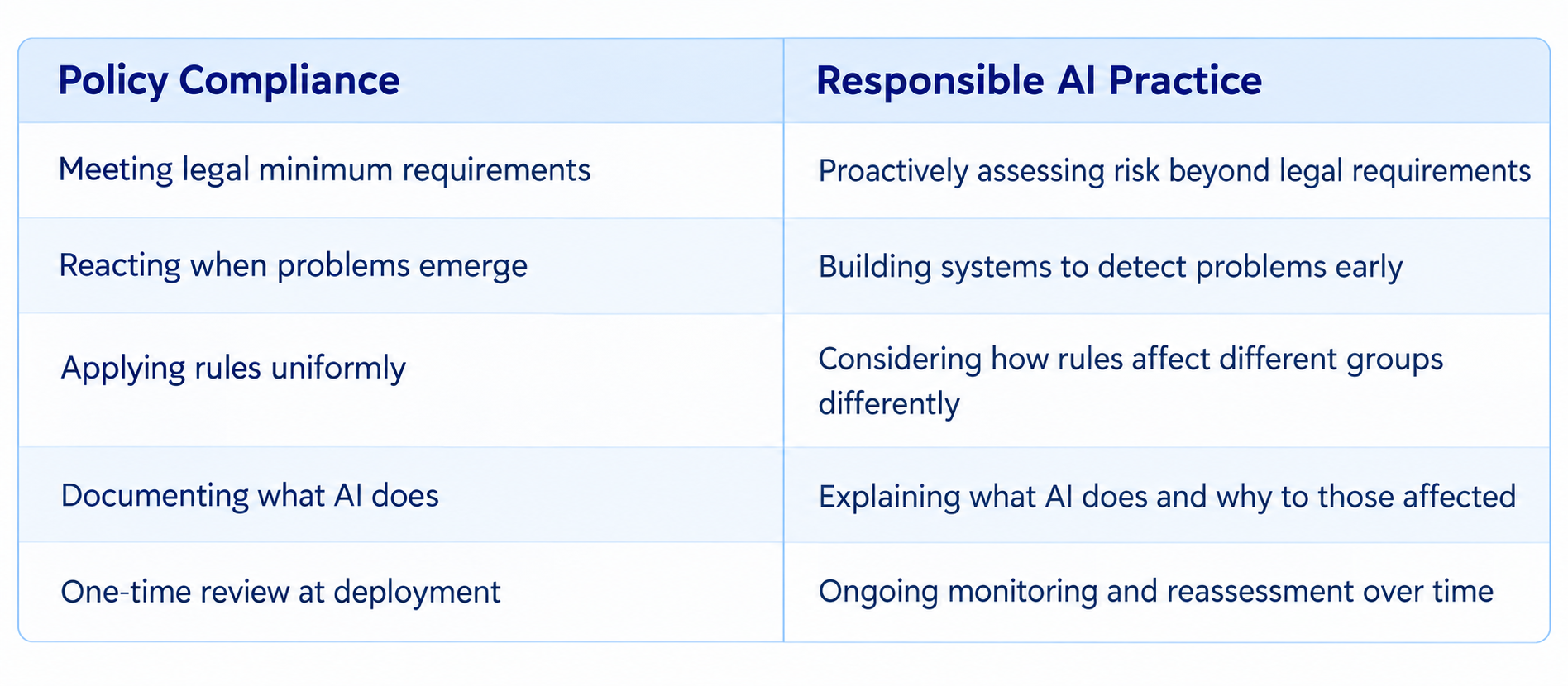
Having an AI policy is not the same as using AI responsibly. One is a document. The other is a practice.
The institutions that are getting this right aren't the ones with the most comprehensive policy documents. They're the ones that have translated values into operational decisions about which tools they'll use, how they'll evaluate them, and what they'll do when something goes wrong.
Responsible AI in higher education isn't a governance checkbox. It's the ongoing work of making sure technology decisions reflect the institution's values even when that's inconvenient.
What Does Responsible AI Use Actually Mean for Universities?
Responsible AI use in higher education means deploying and governing AI systems in ways that are genuinely fair, transparent, accountable, and beneficial and being willing to say no to tools that don't clear that bar, even when they're impressive.
In practice, it means AI tools and decisions that are:
- Fair: AI tools and decisions don't disadvantage particular groups of students or staff
- Transparent: The community understands what AI is being used for and how it works
- Accountable: There are clear owners for AI-assisted decisions and processes for challenging them
- Privacy-respecting: Student data is protected and AI systems operate within legal frameworks
- Academically sound: AI use in teaching, learning, and research upholds the integrity of those activities
- Genuinely beneficial: AI is applied to problems where it adds real value, not deployed for its own sake
This is a more demanding standard than "we have an AI policy." It requires active management, ongoing review, and the organizational willingness to reverse a decision when evidence says it isn't working.
How Is Responsible AI Different From Just Complying With Policy?
Compliance and responsibility aren't the same thing and universities that treat them as equivalent tend to end up with policies that look thorough on paper and don't change much in practice.
A university can comply with data protection law while using AI in ways that are opaque to students and undermine their trust. It can have an academic integrity policy that technically addresses AI while doing nothing to help students understand how to use AI tools ethically. Getting compliant and getting it right are different projects.
What Are the Key Principles of Responsible AI in Higher Education?
Fairness and Equity
AI systems that could significantly affect students or staff should be reviewed for potential bias and unintended impact before they are put into use. Models trained on historical data can embed historical disadvantages. An early-warning system that flags students from underrepresented backgrounds as higher risk not because of their actual ability but because of patterns in historical enrollment data isn't a neutral tool. It's a system that requires careful design, testing, and ongoing monitoring. Fairness isn't a box you tick at launch; it's something you have to keep checking.
Transparency
Students and staff should know when AI is being used in processes that affect them. That includes whether AI is used in admissions screening, how AI-powered advising tools work, and what data feeds the systems that influence their academic experience. Transparency doesn't mean publishing technical documentation that nobody reads. It means providing honest, accessible explanations of what AI does, what it doesn't do, and what its limitations are.
Accountability
When AI contributes to a decision that has a significant impact on a student, there should be clear human oversight and accountability. This means clear escalation paths for students who want to challenge an AI-assisted outcome, and ensuring that AI tools don't operate in ways that diffuse responsibility to the point where nobody owns the consequences. "The algorithm decided" is not an acceptable explanation in an academic context.
Academic Integrity
Responsible AI use in academic contexts means helping students understand what constitutes appropriate use, designing assessments that can coexist with AI tools without losing their validity, and treating academic integrity as a design challenge rather than purely an enforcement challenge. Simply banning the use of AI may not be practical or effective as these tools become more widely available. Neither is blanket permission without guidance. The answer is thoughtful assessment design and clear, consistent expectations.
Data Privacy and Security
AI systems should be reviewed for compliance with applicable privacy requirements, institutional policies, and data-governance standards, including FERPA, GDPR, where applicable, and other relevant regulations. Vendor evaluation for privacy compliance isn't an IT task that happens after the business decision it needs to inform the business decision.
Genuine Educational Value
Responsible AI use isn't just about avoiding harm. It's about deploying AI in ways that genuinely help students learn and staff work effectively and being honest when an AI tool doesn't clear that bar. The pressure to adopt AI for its own sake is real. Resisting it when the use case doesn't stack up is part of what responsible practice looks like.
Where Does Responsible Practice Matter Most?
Student Success Systems
Early-warning systems that identify at-risk students are one of the highest-stakes AI applications in higher education. They can genuinely help but they require careful attention to what the model is predicting, which students it flags more often, and whether the intervention process that follows is equitable and effective. A system that flags the right students but triggers an unhelpful or stigmatizing response hasn't delivered a good outcome.
Admissions
AI tools that assist with application screening or merit assessment carry significant equity implications. Using AI in this context requires explicit bias testing across demographic groups, human review of any AI-assisted decision, and clear documentation of how the tool influences the final outcome. The reputational and legal consequences of getting this wrong are substantial.
Generative AI in Assessment
Decisions about where and how students can use generative AI in assessed work are genuinely difficult. Blanket prohibition isn't working because it's unenforceable and it doesn't prepare students for a world where these tools exist. Blanket permission without guidance doesn't serve students well either. Responsible practice means designing assessments thoughtfully, providing clear and consistent guidance, and treating violations fairly without relying solely on AI-detection tools, which may not always produce reliable results.
Administrative AI
AI tools used in financial aid, timetabling, accommodation, and other administrative functions affect student welfare directly. Responsible deployment means these systems have meaningful human oversight, clear appeals processes, and regular review to check they're working as intended not just technically, but for the students they're supposed to serve.
Research AI
AI-assisted research raises questions about authorship, data integrity, and intellectual contribution that the academic community is still working through. Institutions need clear guidance for researchers not prohibition, but principled frameworks for appropriate use and disclosure that can evolve as the tools evolve.
What Are the Benefits of a Responsible Approach?
Trust
Students, faculty, and staff are more likely to engage positively with AI tools when they understand how they work and trust that they're being used fairly. Trust is hard to rebuild after a high-profile failure and AI failures in higher education have a way of becoming very public very quickly.
Better Outcomes From the Tools Themselves
Reviewing AI systems carefully before deployment can help identify issues with accuracy, bias, privacy, or usability before they become larger problems than those rushed to implementation. The due diligence that responsible adoption requires tends to surface issues early when they're cheap to fix rather than late, when they're not.
Reduced Risk
Responsible AI practice reduces the risk of regulatory action, reputational damage, and the operational disruption that comes from having to withdraw or rebuild a poorly designed system. Poorly implemented AI can create regulatory, reputational, and operational risks, particularly when it affects students or institutional decision-making.
Institutional Leadership
Universities that develop robust responsible AI frameworks position themselves as credible voices in the broader public debate about AI governance. That matters for their reputation, their relationships with regulators, and their contribution to the policy conversations that will shape how AI is used in society.
What Are the Biggest Challenges?
Keeping Up With the Technology
AI tools are evolving faster than governance frameworks. AI is evolving quickly, and guidance written for one generation of technology may not adequately address newer capabilities such as agentic and multimodal AI. Responsible AI practice requires ongoing review, not periodic policy updates that lag years behind the actual deployment landscape.
Faculty Disagreement
Faculty have genuinely different views about appropriate AI use in academic contexts. Some see it as a tool students should learn to use well and critically. Others see it as a fundamental threat to the validity of assessment and the development of genuine competence. Managing this constructively without either imposing a single view or allowing an unmanageable free-for-all is harder than writing a policy.
Vendor Opacity
Many AI vendors don't disclose the details of how their models work, what data they were trained on, or how they perform across demographic groups. Responsible procurement means asking hard questions and being willing to walk away from vendors who can't answer them even when the tool is impressive in a demo.
Resource Constraints
Doing responsible AI well requires investment in technical expertise, in evaluation processes, in training, in communication. Smaller institutions face a genuine challenge in building the capacity to do this properly alongside everything else they're managing. That's a real constraint, not an excuse but it does suggest that sector-wide collaboration on frameworks and tools has value.
How Should Universities Build a Responsible AI Framework?
"What are we trying to protect, and what would it look like if we failed to protect it?"
That question is a better starting point than "what should our AI policy say." From there, a structured approach can follow.
Step 1: Define your values before writing your policies.
Before drafting AI guidelines, articulate what your institution is trying to protect student equity, academic integrity, data privacy, staff trust. Policies that aren't grounded in explicit values tend to be inconsistent and hard to apply in situations the drafters didn't anticipate.
Step 2: Audit what AI tools are already in use.
Before building a forward-looking framework, understand what AI tools are already being used across the institution purchased by central IT, by departments, and by individual staff. You can't govern what you don't know exists. Most institutions are surprised by how many tools are already in use when they do this honestly.
Step 3: Establish a cross-functional AI review process.
No single office can evaluate AI tools properly. A review process should include technical expertise, legal and compliance input, student welfare perspective, faculty representation, and student voice. All AI tools that will be used at institutional scale should go through it before deployment, not after.
Step 4: Develop guidance that's actually usable by different communities.
Faculty need guidance on AI in teaching and research. Students need guidance on academic integrity and how institutional AI affects them. Administrative staff need guidance on AI tools in their workflows. One document can't serve all three audiences. Tailored, accessible guidance gets used; generic policy documents don't.
Step 5: Build monitoring into every deployment from day one.
Responsible AI isn't a sign-off process. Deployed systems need to be monitored for performance, equity impact, and accuracy over time not just checked at launch. Build review cycles into governance from the start, and fund the work needed to conduct those reviews properly.
Step 6: Create real escalation and appeals processes.
Students and staff affected by AI-assisted decisions need to know how to challenge them and those processes need to actually work. Designate clear points of accountability, communicate them clearly, and ensure that raising a concern doesn't require navigating a maze.
What Should a University AI Governance Framework Cover?
At minimum, a responsible AI governance framework for a university should address:
- Tool evaluation and approval processes for institutional AI deployment
- Data privacy and vendor management requirements
- Academic integrity policy covering AI use in assessment
- Equity and bias assessment requirements for student-facing tools
- Transparency and disclosure standards for AI-assisted decisions
- Monitoring and review requirements for deployed systems
- Escalation and accountability processes for affected students and staff
- Research AI guidelines covering disclosure and attribution
“Governance works best when it's built by the people who will live with it not handed down to them. The institutions with the most functional AI governance frameworks have built them through genuine consultation with faculty, staff, and students.”
Frequently asked questions
Responsible AI use for universities means deploying AI tools in ways that are fair to all students and staff, transparent about how they work and what data they use, accountable when they produce bad outcomes, compliant with data protection law, and genuinely beneficial rather than deployed for its own sake. It's a higher standard than policy compliance it requires active management, ongoing review, and the willingness to reverse decisions that aren't working, even when that's inconvenient.
The most effective responses are combining clear, specific guidance with thoughtful assessment design rather than relying on prohibition or detection. Detection tools have documented false positive rates that create serious fairness risks. Assessment design that incorporates oral examination, iterative work with documented process, or in-class components is more robust than trying to detect AI use after the fact. Universities also need to be clear that expectations may differ by course and assignment type consistency within a module matters more than uniformity across the institution.
Responsible evaluation should include: understanding what data the tool accesses and whether that's permissible under FERPA, GDPR, or equivalent frameworks; reviewing the vendor's privacy and security practices; assessing whether the tool has been tested for bias across relevant demographic groups; understanding what the tool does when it produces incorrect outputs; and consulting with the communities who will be most affected by it. Vendor demos are not evaluations. The questions that matter are the ones vendors are least eager to answer.
Treating it as a one-time project rather than an ongoing practice. Universities publish an AI policy, tick the governance box, and move on while the technology landscape continues to evolve and the actual use of AI across the institution diverges further and further from what the policy anticipated. Responsible AI governance requires regular review cycles, real investment in monitoring, and organizational willingness to revisit decisions. The second most common mistake is writing policies without meaningful input from the faculty, staff, and students who will be most affected by them.
Bias assessment should be a condition of deployment, not an afterthought. Before any AI system that makes or informs decisions about students goes live, it should be tested for differential performance across demographic groups including gender, ethnicity, socioeconomic background, and disability status. After deployment, disaggregated outcome monitoring should be a standard operational requirement, with clear triggers for review or suspension if the data suggests differential impact. Universities should also be honest with students about the limitations of AI-assisted systems that affect them.
Not necessarily but it does mean using AI more selectively. Responsible AI practice means being willing to say no to tools that don't meet the bar for fairness, transparency, and genuine benefit even when those tools are technically impressive or commercially attractive. In practice, that often means fewer AI deployments than an institution might pursue if it were optimizing purely for speed of adoption. The trade-off is worth it: fewer systems that actually work well and that the community trusts are more valuable than many systems that generate problems and erode confidence in the institution's judgment.