

Student retention is one of the most consequential metrics a university tracks and one of the most frustrating to move. Every institution knows it matters. Most have dedicated resource to it. The results are often disappointing not because the interventions don't work, but because they're reaching the wrong students too late.
The gap between a student starting to struggle and a student deciding to leave is often measured in weeks. Most traditional retention processes don't close that gap. By the time a student appears on an advisor's radar through a missed appointment, a failed assessment, or a withdrawal request the decision is frequently already made.
The problem with most retention programmes isn't the intervention. It's the timing. By the time a student shows up in someone's caseload, they've often already made the decision to leave.
Data and AI are increasingly changing that. Not by replacing the human relationships that actually retain students, but by identifying warning signs weeks earlier than any advisor could spot them manually and surfacing them to the people who can act before it's too late.
Data and AI don't retain students. People do. But data and AI can make sure the right students reach the right person at the right time before the window closes.
Why Student Retention Is So Hard to Move
Retention is difficult to improve because the factors driving withdrawal are diverse, the signals are often subtle, and the processes for identifying and responding to at-risk students are typically reactive rather than proactive. Three problems show up consistently at institutions that struggle to move their retention numbers:
The Lag Problem
Most indicators of withdrawal risk are visible in student data well before withdrawal happens. Grade trajectories start declining. LMS log-ins drop off. Assessment submissions become late, then missing. These patterns are observable weeks or months before a student withdraws but traditional processes don't pick them up until they've compounded into a crisis.
The Volume Problem
At most universities, the ratio of students to academic advisors makes proactive monitoring of individual student behaviour impossible. An advisor carrying a caseload of several hundred students can't realistically track week-by-week engagement patterns across their whole cohort. Without some form of automated risk identification, proactive outreach is rationed to the students who self-identify and the students most at risk of withdrawal are often the least likely to do that.
The Signal-to-Noise Problem
The same surface behaviour can mean very different things for different students. A student who stops logging into the LMS might be struggling academically, dealing with a personal crisis, or simply accessing content through other means. Distinguishing between these situations and prioritizing accordingly requires a combination of data signals that no single indicator can provide.
What Data and AI Actually Add to Retention
Used well, data and AI address each of these problems. They don't replace human judgment they inform it, earlier and more consistently than manual processes can. Specifically, a data-driven retention approach adds:
- Early identification of at-risk students often potentially weeks before traditional processes would flag them.
- Prioritization of advisor caseloads by risk level rather than first-come-first-served
- Pattern recognition across large populations that no individual can replicate manually
- Tracking of intervention outcomes so the institution can learn what actually works
- Consistent identification across the whole cohort, not just the students who self-refer
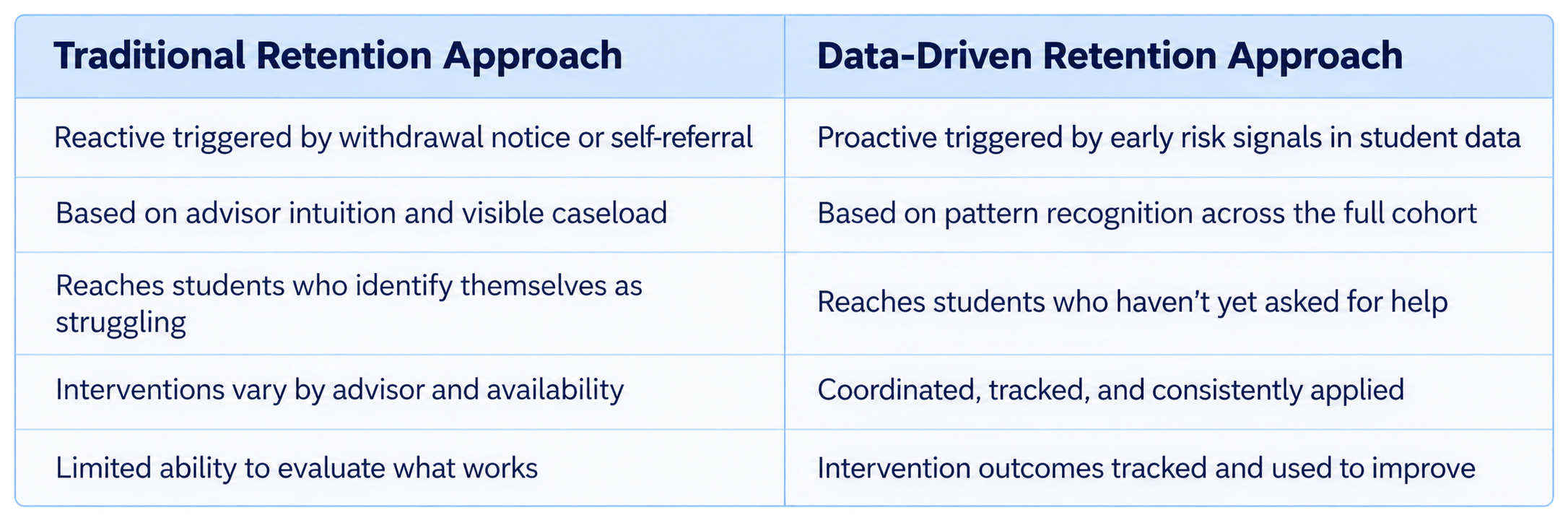
The shift isn't from human to automated. It's from reactive to proactive catching the students who need support before they've already decided they're leaving.
What Data Does a Retention System Need?
The quality of a predictive retention model is determined by the quality and breadth of the data it's built on. Most universities have more relevant data than they realize the challenge is usually connecting it, cleaning it, and governing access to it appropriately.
Academic Performance Indicators
- Grade trajectory not just current grades, but the direction and rate of change
- Assessment submission patterns - late submissions, missed deadlines, partial completions
- Course withdrawal and module failure history
- Progression decisions and retake patterns across academic years
Engagement Indicators
- Learning management system activity - log-in frequency, resource access, time on platform
- Library usage and campus resource engagement
- Attendance data where it's collected consistently
- Participation in scheduled support sessions and tutorials
Demographic and Background Factors
- First-generation student status - students without family experience of higher education often face different challenges
- Financial circumstances and hardship indicators
- Commuter vs residential status - distance from campus correlates with different risk patterns
- Part-time vs full-time enrollment and employment status
Life Events and Circumstances
- Financial aid disruption or emergency fund applications
- Housing instability or accommodation changes
- Highly sensitive student-support information should only be considered where legally permissible, institutionally approved, ethically justified, and governed through strict privacy, consent, and data-minimization practices.
- Disclosed personal circumstances through student support channels
Not every institution will have all of these data sources in a usable form. A data audit mapping what exists, where it lives, how complete it is, and what governance applies is usually the first practical step before any model work begins.
How Predictive Models Work in Student Retention
The AI component of a retention system is typically a predictive model trained on historical student data to identify patterns associated with withdrawal risk.
In plain terms: the model looks at what students who withdrew in previous years looked like in their data during the weeks before they left and compares that to students who didn't withdraw. It learns which combination of signals, at which point in the academic year, is most predictive of withdrawal risk for this particular institution and cohort.
The output is a risk score, not a decision. A student flagged as high-risk isn't being told they will withdraw they're being identified as someone who would benefit from proactive outreach. The decision about what to do with that signal rests with a human: a personal tutor, an academic advisor, or a student success coordinator.
This distinction matters. The model identifies. People decide. Designing the system with that boundary clearly drawn is one of the most important decisions in implementation and one that's too often overlooked when institutions are focused on the technology.
What Good Retention Interventions Look Like
A predictive model is only as useful as the intervention process connected to it. Institutions that have invested in early warning systems without redesigning their outreach and support processes typically see limited impact because generating a list of at-risk students doesn't help anyone if nobody has the capacity or the process to act on it.
Outreach Should Feel Personal, Not Algorithmic
A message that reads like a system notification "our records show you may be experiencing difficulties" tends to feel more like surveillance than support. Effective outreach is personal: a tutor reaching out by name, referencing something specific about the student's course, and asking how things are going rather than announcing that an algorithm has flagged them. The model informs the conversation; it shouldn't define it.
Interventions Should Match the Risk Factor
A student flagged for academic disengagement and a student flagged for financial hardship need different responses. The most effective retention systems connect risk profile to intervention type: academic support, financial advice, counselling referral, peer mentoring, or personal tutor conversation depending on what the data suggests is driving the risk.
Outreach Should Be Tracked
If nobody records whether a flagged student was contacted, what the outcome was, and whether their risk score subsequently improved, the institution can't learn which interventions work. Tracking isn't bureaucracy it's the mechanism by which the system gets better over time.
What Are the Benefits?
Improved Retention Rates
Institutions that have implemented early warning systems carefully and connected them to effective intervention processes have reported meaningful improvements in first-year to second-year retention. The magnitude varies by institution, baseline, and implementation quality but Institutions that combine early-warning capabilities with effective intervention processes have reported improvements in retention, although results vary significantly by institution and implementation approach.
Better Use of Advisor and Support Staff Time
Prioritizing caseloads by risk level means that advisor time goes to the students who need it most, rather than those who are most visible or most persistent in seeking help. That's a better use of limited resource and it tends to reduce the burnout that comes from reactive, crisis-driven workloads.
More Equitable Support
Students from disadvantaged backgrounds are disproportionately likely to withdraw and disproportionately unlikely to self-identify and ask for help. Proactive, data-driven outreach reaches students who wouldn't otherwise appear on anyone's radar until it was too late. That's one of the clearest equity benefits of this approach, when it's implemented with appropriate care.
An Evidence Base for What Works
Most retention programmes operate without good evidence about which interventions actually reduce withdrawal risk. A system that tracks outreach and outcomes creates, over time, a genuine evidence base allowing institutions to invest in what works and stop doing what doesn't.
Financial Impact
Each retained student represents significant income tuition, associated revenue, and in many cases public funding tied to enrollment and completion. The return on investment from retention work, when calculated honestly, is typically substantial. Even modest improvements in retention can create meaningful financial returns, particularly where tuition and funding are closely tied to enrollment and completion.
What Are the Risks and Challenges?
Equity and Bias in the Model
This is the most important challenge and the one most often underweighted in implementation planning. If historical data reflects historical inequities if students from particular backgrounds withdrew at higher rates due to systemic barriers rather than individual factors a model trained on that data will predict higher risk for similar students today. Bias assessment isn't a one-time check at launch; it's an ongoing monitoring requirement.
Privacy and Student Consent
Institutions should be transparent with students about how engagement and behavioral data may be used, consistent with applicable laws, institutional policies, and privacy requirements. Institutions need clear, accessible policies about what data feeds the system, how risk scores are used, how long data is retained, and what rights students have to access or challenge information about themselves.
The Over-Intervention Problem
Not every flagged student wants or needs proactive outreach. Some will experience it as unwanted surveillance rather than genuine support, particularly if the outreach feels impersonal or poorly timed. Designing interventions that feel supportive rather than intrusive requires as much thought as designing the model.
Data Quality
Predictive models are only as good as the data they're built on. Patchy attendance records, inconsistently captured LMS data, and student services information siloed across separate systems all limit model quality. Data quality issues need to be addressed as a prerequisite to model development, not as a problem to solve later.
Advisor Capacity
A model that generates a long list of at-risk students is only useful if the people receiving that list have the capacity to act on it. If advisors are already at capacity, generating more referrals doesn't improve outcomes it just changes the composition of the backlog. Retention technology and advisor resourcing need to be planned together.
How Should Universities Approach This?
The institutions that have made genuine progress on data-driven retention have tended to approach it as a programme of change, not a technology project. The model is one part of it. The data infrastructure, the governance, the intervention design, and the cultural shift in how advisors think about their caseloads are equally important.
Step 1:
Start with the retention problem, not the technology. Understand where and when withdrawal happens at your institution. Which cohorts? At which point in the year? With what prior signals? This analysis shapes what the model needs to detect and what data is most important to collect.
Step 2:
Audit your data before selecting a platform. Map what student data exists, where it lives, how complete and reliable it is, and what governance applies. Data quality is usually the binding constraint on model quality. Knowing your data landscape before evaluating vendors means you can ask the right questions.
Step 3:
Establish governance from the start. Decide who can see risk scores, who makes outreach decisions, how intervention activity is recorded, and what rights students have to understand and challenge their risk designation. These decisions are harder to retrofit after deployment than to build in from the beginning.
Step 4:
Design the intervention process alongside the model. A risk score without a clear, resourced intervention process doesn't improve retention. Before the model goes live, the outreach process needs to be defined: who acts on which signals, within what timeframe, with what resources, and how outcomes are recorded.
Step 5:
Pilot with a bounded cohort before institution-wide rollout. Start with a defined group where you can evaluate the model's predictions against actual outcomes, assess equity impacts, and refine the intervention process before scaling. A successful bounded pilot builds institutional confidence and surfaces problems cheaply.
Step 6:
Measure outcomes and continuously improve. Track whether outreach to flagged students improved their outcomes. Disaggregate results by student group to monitor for differential impact. Use what you learn to refine the model, the intervention approach, and the outreach process each year.
Build vs Buy - and What to Look for in Either Case
Whether building or buying, the questions that matter most are:
- What data does the system need, and does the institution have it in a usable form?
- How does the model handle equity and bias what testing has been done across demographic groups?
- How transparent is the model can advisors understand why a student has been flagged?
- How does the system integrate with existing student information systems and case management tools?
- What does the vendor or platform provide beyond the model intervention workflow, outcome tracking, reporting?
- How is student data handled, stored, and protected?
The technology decision is secondary to the programme design decision. The most capable early warning platform is only as effective as the intervention process and advisor capacity connected to it.
Frequently asked questions
The most commonly used data falls into four categories: academic performance data (grades, grade trajectory, assessment submission patterns, module failures), engagement data (LMS log-in frequency, library usage, attendance where collected), demographic and background factors (first-generation status, financial circumstances, commuter vs residential, part-time vs full-time), and life event indicators (financial aid changes, housing instability, contact with support services). The combination of signals across these categories is more predictive than any single indicator. Data quality and completeness matter more than the sophistication of the model.
Accuracy varies significantly by institution, data quality, and how the model is specified. The more important question isn't accuracy in an abstract sense it's whether the system identifies at-risk students early enough for intervention to make a difference, and whether it does so equitably across demographic groups. A model that's accurate on average but systematically over-flags one student group is not a good model, regardless of its headline accuracy figure.
Yes, and they need to be addressed proactively. Using data about student behaviour to assess withdrawal risk requires a clear legal basis under FERPA (US), GDPR (Europe), or equivalent frameworks. Students should know that this data is being used, what it's used for, and what their rights are. Institutions need data retention policies for risk scores, access controls limiting who can see risk designations, and clear processes for students who want to understand or challenge how their data is being used.
Bias mitigation requires attention at multiple stages. During model development, training data should be assessed for historical inequities. The model's predictions should be tested for differential accuracy and differential false positive rates across demographic groups before deployment. After deployment, disaggregated outcome monitoring tracking whether the intervention process is reaching and benefiting all student groups equitably should be a standard ongoing requirement, not a one-time review.
No - and the institutions that have tried to use it as a replacement have generally produced poor outcomes. Data and AI identify which students may need support and provide advisors with more information when they make contact. The relationship, the conversation, and the judgment about what support is appropriate remain firmly human. The ratio of students to advisors is often the real binding constraint on retention outcomes and that's a resourcing question, not a technology question.
The full cycle from implementation to measurable retention improvement typically takes at least one full academic year because retention is measured over an academic year, and the model needs a complete cycle of data to train on and outcomes to evaluate against. A well-designed programme should define leading indicators it will track from day one advisor caseload efficiency, number of proactive contacts made, student response rates rather than waiting for annual retention statistics to confirm whether it worked.