
Artificial intelligence is rapidly moving from experimentation to everyday business use.
Organizations are using AI to automate repetitive work, analyze information, improve customer and employee experiences, accelerate decision-making, and create new ways of working.
But using an AI chatbot or testing a generative AI tool isn't the same as implementing enterprise AI.
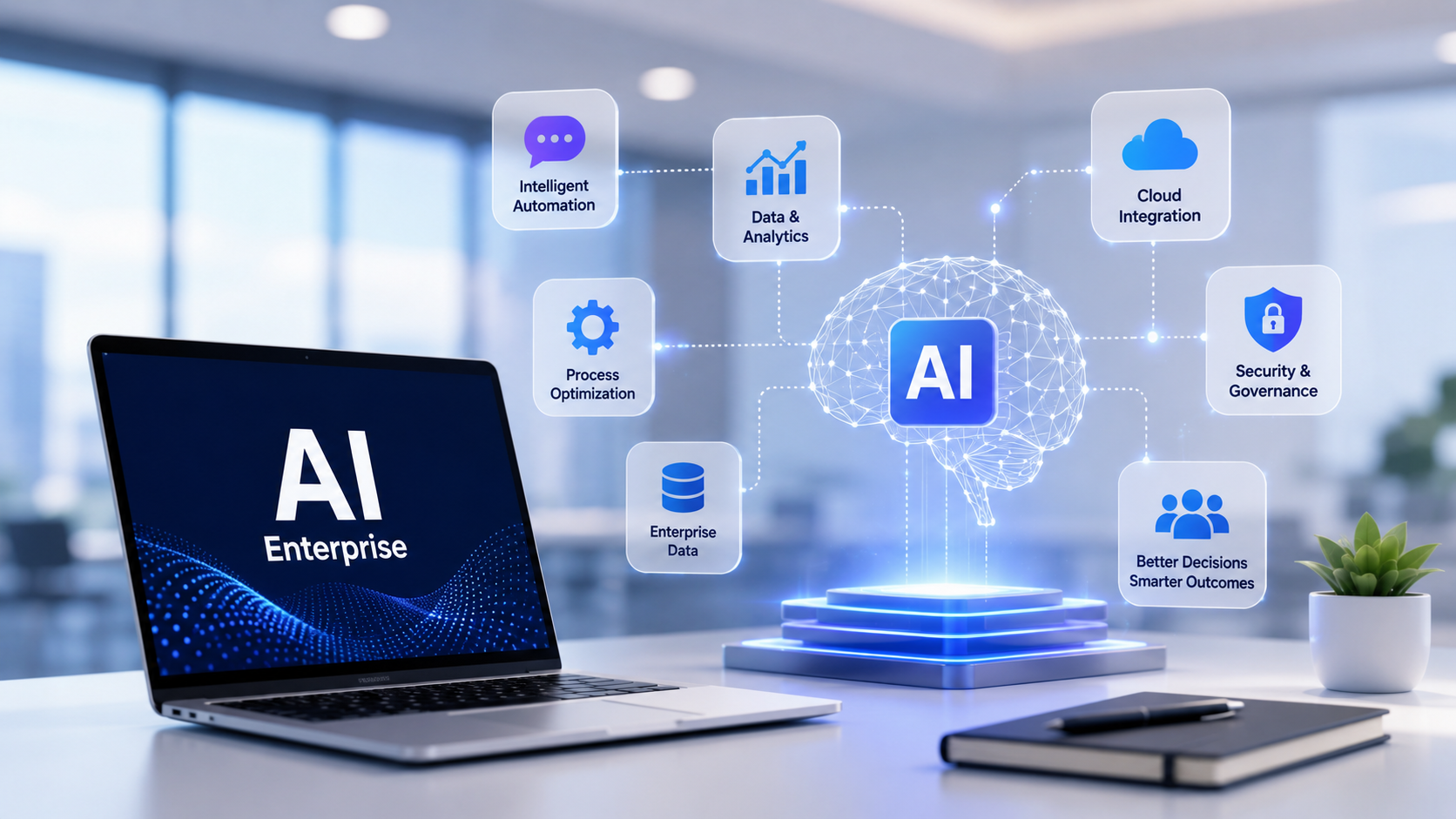
Enterprise AI requires organizations to think about business value, data, integration, security, governance, scalability, and people—not just the AI model itself.
What Is Enterprise AI?
Enterprise AI is the use of artificial intelligence across an organization to solve business problems, automate processes, improve decision-making, and enhance customer and employee experiences at scale.
Unlike standalone consumer AI tools, enterprise AI is typically connected to an organization's data, applications, workflows, and business processes while operating within defined requirements for security, privacy, governance, and access.
Enterprise AI can include technologies such as:
- Generative AI
- Machine learning
- Natural language processing
- Computer vision
- Predictive analytics
- Intelligent automation
- AI assistants and copilots
- AI agents
The technology itself, however, is only one part of enterprise AI.
The larger challenge is turning AI capabilities into reliable, secure, and useful business solutions.
How Is Enterprise AI Different From Regular AI?
The difference is largely about context, scale, and responsibility.
A consumer might use an AI tool to summarize an article or write an email.
An enterprise might need AI to analyze information across multiple approved business systems, help employees find internal knowledge, automate parts of a workflow, assist customer-service teams, or identify patterns across large datasets.
That introduces additional considerations.
Enterprise AI therefore requires more than simply providing employees with access to an AI model.
What Are the Main Types of Enterprise AI?
Organizations can use AI in several different ways.
Generative AI
Generative AI creates new content based on instructions and available information.
It can help generate or summarize:
- Text
- Documents
- Emails
- Reports
- Images
- Code
- Knowledge responses
Predictive AI
Predictive AI analyzes historical data to identify patterns and estimate what may happen next.
Organizations might use it for forecasting, risk identification, demand planning, lead scoring, or operational analysis.
Conversational AI
Conversational AI enables users to interact with technology through natural language.
Examples include customer-service assistants, employee support assistants, and internal knowledge assistants.
Intelligent Automation
AI can be combined with automation technologies to handle repetitive tasks, classify information, extract data, route requests, and support business workflows.
Agentic AI
Agentic AI extends beyond simply generating an answer.
An AI agent can potentially reason through a task, determine appropriate steps, interact with authorized tools or systems, and perform actions toward a defined objective.
Because agents can take actions, organizations need appropriate permissions, monitoring, governance, and human oversight.
What Are Common Enterprise AI Use Cases?
The best enterprise AI use cases usually start with a business problem, not with the technology.
Some common examples include:
Customer Service
AI can help summarize cases, suggest responses, retrieve relevant knowledge, categorize requests, and assist service teams.
Employee Knowledge
An internal AI assistant can help employees find information across approved policies, documentation, knowledge bases, and other organizational resources.
Instead of searching across multiple systems, employees can ask questions using natural language.
Document Processing
Organizations process large volumes of contracts, forms, invoices, applications, reports, and other documents.
AI can assist with:
- Information extraction
- Classification
- Summarization
- Document routing
- Content analysis
Sales and Marketing
AI can support activities such as lead analysis, customer insights, content assistance, campaign personalization, research, and sales preparation.
IT and Operations
AI can assist with support requests, knowledge retrieval, incident analysis, documentation, workflow automation, and operational monitoring.
Data and Analytics
AI can make it easier for authorized users to interact with organizational data, identify patterns, summarize information, and support decision-making.
The right use case depends on the organization's processes, data, risk tolerance, and desired outcomes.
What Are the Benefits of Enterprise AI?
When implemented strategically, enterprise AI can provide several advantages.
Increased Productivity
AI can reduce time spent searching for information, summarizing content, creating routine materials, and completing repetitive tasks.
Faster Decision-Making
AI can help organizations analyze large amounts of information and surface relevant insights more quickly.
Better Customer Experiences
AI-assisted service and personalization can help organizations respond more efficiently and provide more relevant experiences.
Reduced Manual Work
Combining AI with automation can reduce repetitive administrative tasks and allow employees to focus on work requiring greater judgment or expertise.
Better Use of Organizational Knowledge
Important information is often scattered across documents, systems, emails, and knowledge repositories.
Enterprise AI can help make approved organizational knowledge easier to discover and use.
Scalable Operations
AI-powered workflows can help organizations handle growing volumes of information and requests without requiring every process to scale manually.
What Are the Biggest Challenges With Enterprise AI?
Implementing AI at enterprise scale creates challenges that organizations need to address early.
Data Quality
AI is only as useful as the information available to it.
Incomplete, outdated, fragmented, or poorly governed data can reduce the quality of AI outputs.
Security and Privacy
Enterprise AI may interact with confidential organizational information.
Organizations need controls around what information AI can access, who can use it, and how data is protected.
AI Governance
Organizations need policies defining appropriate AI usage, accountability, oversight, risk management, and decision-making responsibilities.
Integration
AI creates more value when it can work with the systems employees already use.
That can require integration with CRM, ERP, data platforms, knowledge systems, collaboration tools, and other enterprise applications.
Accuracy
Generative AI systems can produce incorrect or unsupported information.
Organizations should determine where verification, source grounding, human review, or additional controls are necessary.
Adoption
Even technically successful AI projects can fail if employees don't understand why or how they should use them.
Training and change management are therefore important components of enterprise AI adoption.
How Should Organizations Implement Enterprise AI?
Enterprise AI shouldn't begin with:
“We need AI. What can we do with it?”
A better starting point is:
“What business problem are we trying to solve?”
From there, organizations can follow a more structured approach.
Step 1: Identify the Business Problem
Look for processes that are repetitive, information-heavy, slow, difficult to scale, or dependent on employees manually searching for information.
Step 2: Define the Desired Outcome
Determine what success should look like.
For example:
- Reduce response time
- Reduce manual processing
- Improve employee productivity
- Improve customer experience
- Make organizational knowledge easier to access
Step 3: Assess Data and Systems
Identify what information the AI needs and where that information currently exists.
Step 4: Evaluate Risk
Consider privacy, security, accuracy, regulatory requirements, access permissions, and the consequences of incorrect AI outputs.
Step 5: Start With a Focused Use Case
Instead of attempting organization-wide transformation immediately, begin with a use case that has clear value and manageable risk.
Step 6: Integrate With Existing Workflows
Employees shouldn't have to completely change how they work to benefit from AI.
Where appropriate, AI should connect with existing applications and processes.
Step 7: Establish Human Oversight
Determine where AI can assist, where it can automate, and where a person should review or approve an action.
Step 8: Measure Results and Scale
Track whether the implementation is actually improving the outcome defined at the beginning.
Successful use cases can then provide a foundation for broader adoption.
What Is the Role of AI Governance?
AI governance defines how an organization manages AI responsibly.
An enterprise AI governance framework may address:
- Approved AI tools
- Data access
- Privacy
- Security
- Human oversight
- AI-generated content
- Accuracy and validation
- Risk classification
- Monitoring
- Accountability
Governance shouldn't exist simply to restrict AI.
Good governance helps organizations adopt AI with clearer boundaries and greater confidence.
Should Organizations Build or Buy Enterprise AI?
There isn't one answer for every organization.
Some needs can be addressed effectively through existing enterprise AI products.
Others may require customized solutions that connect AI models with proprietary data, business rules, workflows, and systems.
The decision should consider:
Business requirements → Existing technology → Data → Integration → Security → Customization → Cost → Scalability
Organizations also don't necessarily need to choose entirely between building and buying.
A common approach is to combine established AI platforms and models with custom integrations, workflows, interfaces, and governance.
Frequently Asked Questions About Enterprise AI
Moving From AI Experimentation to Enterprise Value
The question for organizations is increasingly moving from “Should we use AI?” to “Where can AI create meaningful business value?”
Enterprise AI isn't about adding AI to every process.
It's about identifying the right problems, connecting AI with trusted organizational data and systems, establishing appropriate governance, and designing solutions that people can actually use.
Organizations that build these foundations can move beyond isolated AI experiments toward AI capabilities that are secure, scalable, integrated, and measurable.
Sparient helps organizations evaluate enterprise AI opportunities, build AI-powered solutions and agents, integrate AI with existing enterprise systems, and establish scalable approaches to automation and digital transformation.
The goal isn't simply to implement AI.
It's to turn AI into practical business value.