
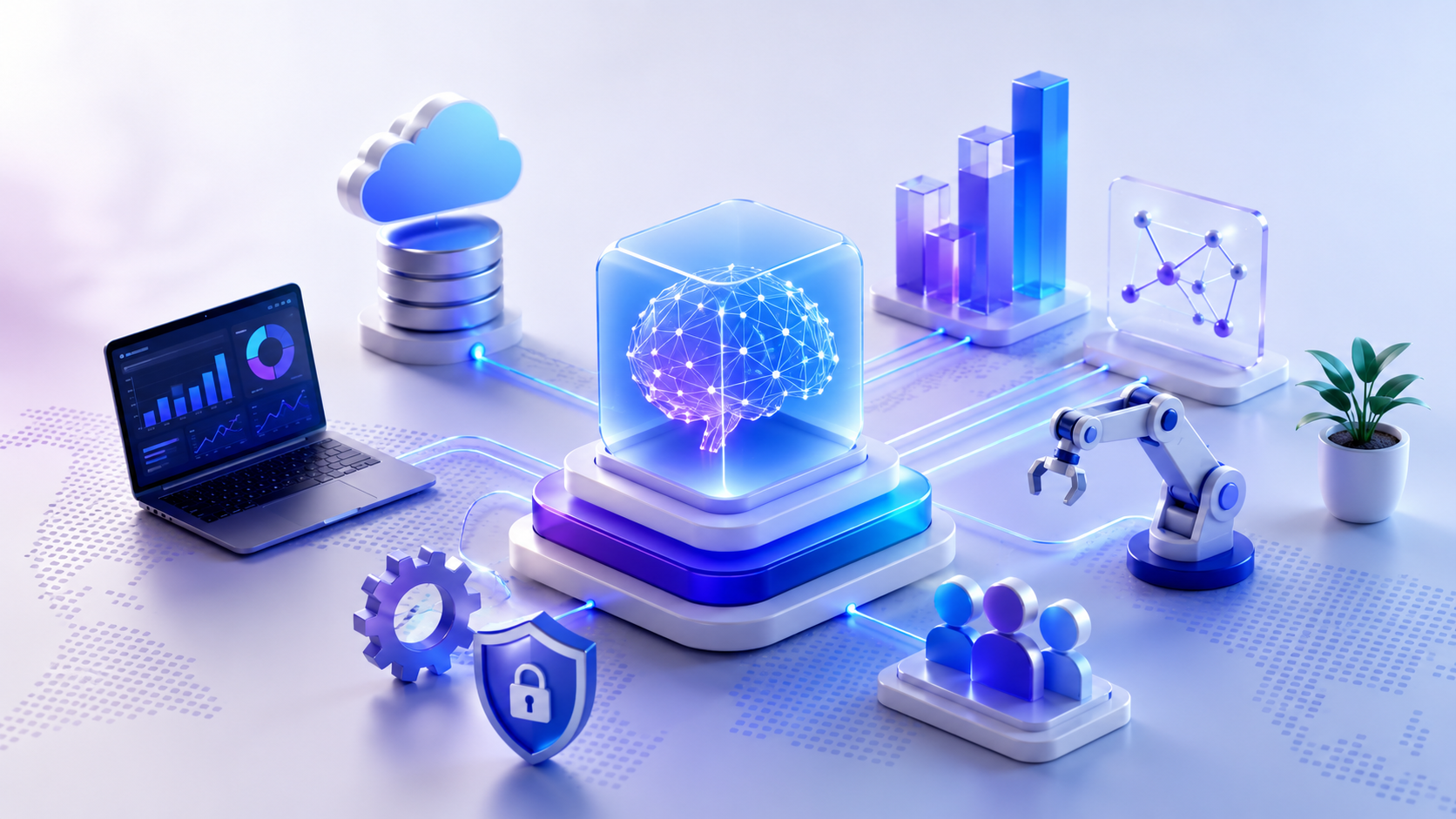
Artificial intelligence is no longer limited to research labs or experimental projects. Organizations are using AI to analyze data, automate routine work, improve customer experiences, support employees, generate content, detect risks, and make faster decisions. But using an AI chatbot for a few individual tasks is very different from deploying AI securely across an entire organization. That is where Enterprise AI comes in.
Enterprise AI combines artificial intelligence technologies with an organization’s data, applications, workflows, security controls, and governance practices so AI can be used reliably at scale. It can include machine learning, predictive analytics, generative AI, natural language processing, computer vision, and increasingly, AI agents capable of completing multi-step tasks.
In this guide, we explain what Enterprise AI means, how it works, where organizations can use it, the challenges involved, and how to approach implementation successfully.
What Is Enterprise AI?
Enterprise AI is the use of artificial intelligence across an organization to automate processes, analyze information, support decision-making, and improve how employees and customers interact with business systems.
The important word is enterprise.
Enterprise AI is not simply giving employees access to an AI tool. An enterprise-grade AI environment must work with existing business applications and data while meeting organizational requirements for security, privacy, governance, reliability, compliance, and scalability.
For example, an employee asking a public AI assistant to summarize a document is an individual AI use case.
An organization deploying an AI assistant that securely searches approved internal documents, understands employee permissions, connects with business systems, and helps complete workflows is an Enterprise AI use case.
The difference is integration, scale, control, and business context.
How Is Enterprise AI Different from Generative AI?
Enterprise AI and generative AI are related, but they are not the same thing.
Generative AI refers to AI capable of generating new content such as text, images, code, audio, or summaries.
Enterprise AI is the broader organizational approach to implementing AI technologies within business operations.
Enterprise AI may include:
Generative AI
Machine learning
Predictive analytics
Natural language processing (NLP)
Computer vision
Intelligent automation
AI copilots
AI agents
Recommendation systems
Retrieval-Augmented Generation (RAG)
Think of generative AI as one capability within a larger Enterprise AI ecosystem.
How Does Enterprise AI Work?
Enterprise AI typically connects several layers of an organization's technology environment.
At the foundation is enterprise data. This may include CRM information, ERP data, documents, customer records, analytics platforms, knowledge bases, operational systems, and other approved information sources.
AI models and applications then use this information to understand requests, identify patterns, generate responses, make predictions, or automate tasks.
For generative AI applications, organizations may use Retrieval-Augmented Generation (RAG) to connect an AI model with approved enterprise knowledge. Instead of relying only on information contained in a model's training data, RAG allows the system to retrieve relevant organizational information when generating a response.
The AI layer can then be integrated into the applications employees already use.
A simplified Enterprise AI architecture might look like:
Enterprise Data → AI Models → Business Applications → Automated Workflows → Employees & Customers
Around all these layers should be security, access controls, monitoring, governance, and human oversight.
Common Enterprise AI Use Cases
The value of Enterprise AI becomes clearer when it is connected to specific business problems.
1. Customer Service
AI-powered assistants can help organizations answer customer questions, summarize previous interactions, recommend responses, categorize requests, and route complex issues to the appropriate teams.
Instead of replacing customer service teams, AI can reduce repetitive work and give representatives faster access to the information they need.
2. Marketing and Sales
Marketing teams can use Enterprise AI to analyze customer behavior, identify audience segments, personalize communications, summarize market research, generate content variations, and analyze campaign performance.
Sales teams can use AI to summarize accounts, identify potential opportunities, prioritize leads, prepare for meetings, and recommend next actions based on CRM data.
3. Document and Knowledge Management
Large organizations often have thousands or even millions of documents distributed across different systems.
Enterprise AI can help employees search organizational knowledge using natural language, summarize documents, extract important information, compare documents, and locate relevant policies or procedures.
For example, instead of manually searching through hundreds of pages of documentation, an employee could ask:
"What is our policy for approving contracts above $100,000?"
An enterprise AI assistant could retrieve information from approved organizational sources and provide the relevant answer.
4. IT Operations
Enterprise AI can support IT teams by analyzing incidents, identifying patterns, summarizing support tickets, recommending troubleshooting steps, generating technical documentation, and automating repetitive support workflows.
AI agents can potentially take this further by performing multi-step tasks across approved systems while operating within defined permissions and human oversight.
5. Finance
Finance teams can use AI for forecasting, anomaly detection, financial analysis, invoice processing, reporting, and fraud detection.
AI can also help employees analyze large datasets and identify patterns that may be difficult to detect manually.
6. Human Resources
HR teams can use Enterprise AI to support employee knowledge portals, answer policy questions, summarize employee feedback, assist with onboarding, create job descriptions, and automate administrative processes.
Sensitive HR applications require particularly strong controls around privacy, permissions, bias, and appropriate human oversight.
7. Legal and Compliance
AI can help legal and compliance teams review contracts, extract important clauses, compare document versions, summarize regulatory information, organize audit documentation, and identify potential compliance risks.
Human review remains especially important when AI is used for decisions or recommendations with significant legal or regulatory consequences.
What Are the Benefits of Enterprise AI?
When implemented around clear business objectives, Enterprise AI can provide benefits across multiple functions.
Higher productivity: AI can automate repetitive tasks and help employees find, analyze, and create information faster.
Faster decision-making: AI can process large amounts of organizational data and surface insights that help teams make more informed decisions.
Better customer experiences: Organizations can provide faster support, personalized interactions, and more consistent experiences across channels.
Improved access to organizational knowledge: Enterprise AI can make information stored across documents, databases, and applications easier for employees to discover and use.
Operational efficiency: Automated workflows can reduce manual steps, bottlenecks, and repetitive administrative work.
Scalability: Once properly designed and governed, AI capabilities can be extended across departments, workflows, and business units.
The goal should not simply be to "use AI." Organizations should connect AI investments to measurable outcomes such as reduced processing time, lower operating costs, improved customer satisfaction, increased employee productivity, or better decision-making.
What Are the Challenges of Enterprise AI?
Enterprise AI introduces significant opportunities, but organizations also need to manage several challenges.
Data Quality
AI is only as useful as the information available to it.
Incomplete, outdated, duplicated, poorly structured, or inaccessible enterprise data can reduce the accuracy and usefulness of AI systems.
Organizations therefore need strong data management practices alongside their AI strategy.
Security and Privacy
Enterprise AI systems may interact with confidential business information, intellectual property, employee records, customer information, or regulated data.
Organizations need appropriate access controls, authentication, encryption, monitoring, and data protection policies to ensure AI systems only access information they are authorized to use.
AI Governance
As organizations deploy more AI systems, they need policies defining:
Which AI tools employees can use
What data can be shared with AI systems
Who is responsible for AI applications
Where human approval is required
How AI systems are evaluated
How risks and incidents are reported
How models and AI agents are monitored
The NIST AI Risk Management Framework provides organizations with a voluntary framework for managing AI risks and improving trustworthiness throughout the AI lifecycle. Its core functions include Govern, Map, Measure, and Manage.
Integration with Existing Systems
Enterprise organizations rarely operate from a single application.
AI may need to connect with CRM systems, ERP platforms, cloud environments, data warehouses, document repositories, APIs, collaboration tools, and legacy applications.
Successful Enterprise AI therefore depends as much on integration architecture as it does on the AI model itself.
Accuracy and Reliability
Generative AI systems can produce incorrect or misleading information.
Organizations need appropriate evaluation, grounding, monitoring, and human oversight—particularly for high-impact use cases.
Employee Adoption
Technology alone does not create transformation.
Employees need to understand what AI can do, when they should use it, what information they can provide to it, and when outputs require human verification.
Training and change management should therefore be part of an Enterprise AI strategy from the beginning.
Enterprise AI and AI Agents
One of the most important developments in Enterprise AI is the emergence of AI agents.
Traditional generative AI generally responds to a request and produces an output.
AI agents can go further by reasoning through a task, determining a sequence of actions, interacting with connected systems, and executing parts of a workflow.
For example, an AI assistant might tell an employee which invoices are overdue.
An AI agent could potentially:
Identify overdue invoices → retrieve account information → prepare follow-up communications → update the relevant system → escalate high-risk accounts for human review.
This moves Enterprise AI from simply providing information toward helping execute business processes.
As agents gain greater ability to take actions across enterprise systems, identity management, permissions, monitoring, governance, and human oversight become increasingly important.
How to Get Started with Enterprise AI
Organizations do not need to transform every process at once.
A practical Enterprise AI journey can begin with a focused approach.
Step 1: Identify Business Problems
Start with the problem rather than the technology.
Ask:
Where are employees spending significant time on repetitive work?
Where is important information difficult to find?
Which processes have unnecessary manual steps?
Where could faster analysis improve decisions?
These questions help identify practical AI opportunities.
Step 2: Prioritize High-Value Use Cases
Evaluate potential AI projects based on factors such as business value, implementation complexity, data availability, security requirements, and measurable impact.
A focused internal knowledge assistant, for example, may provide a better starting point than attempting to automate an entire department.
Step 3: Assess Your Data
Determine where the necessary information exists, who owns it, how accurate it is, and who should have access.
Organizations may need to improve data quality and governance before introducing AI into critical workflows.
Step 4: Establish AI Governance
Define policies for responsible AI use before scaling deployment.
Governance should address security, privacy, accountability, access, monitoring, compliance, model evaluation, and human oversight.
NIST recommends treating governance as an ongoing component of AI risk management rather than a one-time exercise.
Step 5: Select the Right AI Architecture
Organizations should determine whether a use case requires generative AI, predictive models, RAG, AI agents, workflow automation, or a combination of technologies.
The architecture should also account for integration with existing cloud, data, identity, and enterprise application environments.
Step 6: Start with a Pilot
Deploy AI within a controlled use case.
Measure outcomes such as:
Time saved
Cost reduction
Response accuracy
Employee adoption
Customer satisfaction
Process completion time
Error reduction
Use those findings to improve the system before expanding it.
Step 7: Scale What Works
Once a use case demonstrates measurable value, organizations can integrate it more deeply into workflows and expand successful capabilities across additional teams.
This approach reduces risk while helping organizations develop the technical, operational, and governance capabilities required for larger AI initiatives.
What Does the Future of Enterprise AI Look Like?
Enterprise AI is moving beyond standalone chatbots toward AI embedded directly within business applications and workflows.
Organizations are increasingly connecting generative AI, enterprise data, automation, and AI agents so systems can not only answer questions but also assist with completing work. IBM describes agentic AI as a growing component of Enterprise AI, while Microsoft similarly emphasizes governed AI agents operating across real business workflows.
The organizations that benefit most from this shift are unlikely to be those that simply deploy the largest number of AI tools.
The advantage will come from connecting AI + trusted data + enterprise systems + governance + human expertise around meaningful business outcomes.
Enterprise AI Is a Business Transformation, Not Just a Technology Project
Enterprise AI has the potential to change how organizations operate, make decisions, serve customers, and empower employees.
But successful adoption requires more than selecting an AI model.
Organizations need the right data foundation, integration architecture, security controls, governance framework, business processes, and adoption strategy to move AI from experimentation into production.
For organizations beginning their Enterprise AI journey, the most practical approach is simple:
Start with a real business problem. Build a focused solution. Measure the results. Establish the right controls. Then scale what works.
That is how Enterprise AI moves from an interesting technology initiative to a sustainable organizational capability.